By Liam Spindler, Founding Partner
Since the Russian Invasion of Ukraine in February 2022, the Ukrainian government has presented a consistent and disciplined communications strategy aimed at mobilising international support and sustaining domestic morale. Ukraine’s external objectives have been clear: to secure military, financial, and political support from friendly countries. Although striking a chord with key audiences by presenting themselves as victims of unprovoked aggression, not all global audiences have been receptive to this messaging, and sympathies have gradually waned as a state of crisis has given way to protracted conflict.
The Ukrainian case offers valuable lessons on how effective narrative building and messaging can deliver rewards in times of crises but also warns of the risks of narrative fatigue and losing control of perceptions as events evolve over time.
Narrative strategy amidst crisis and effective leadership
Ukraine has consistently framed itself as a small nation under assault from a vastly more powerful neighbour. While this narrative has deeper historical roots, it accelerated following Russia’s occupation of Crimea and support for separatist movements in Donbas and Luhansk in 2014. However, the Invasion in 2022 marked a clear fissure in European Security, providing Ukraine the opportunity to embed its messaging with a more potent moral element. Conflict with Russia was no longer positioned simply as a local issue or territorial dispute, but as a contest between freedom and totalitarianism. The effect was to simplify complex historical and cultural factors into a moral dilemma and story that could be quickly understood and emotionally processed by external audiences.
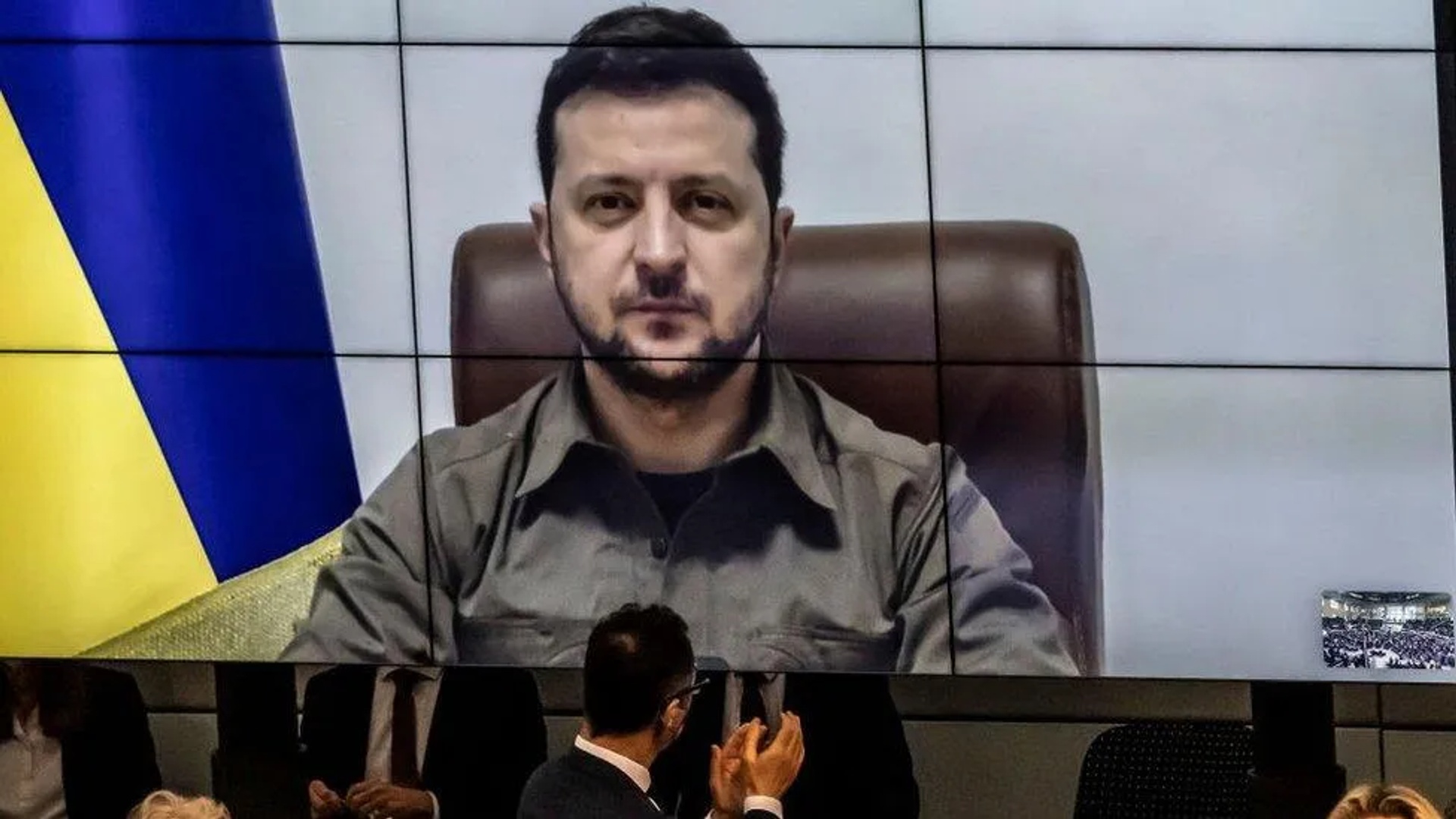
This framing has been largely centred on President Volodymyr Zelensky himself. In the opening days of the war, he reinforced his decision to stay in Kyiv by publishing a series of video messages alongside senior military and civilian leaders, a powerful act of leadership which conveyed authenticity and demonstrated personal bravery, rallying the Ukrainian population to resist. His adoption of military fatigues played a key visual role in cementing his brand as a wartime leader, which along with the now famous remark to Joe Biden, ‘I need ammunition, not a ride’ becoming emblematic of wider Ukrainian national resistance.
Lesson 1: In times of crisis, detailed analysis should give way to simplicity, clarity and moral messaging. Or, In the words of Ronald Reagan, ‘if you’re explaining, you’re losing’. When audiences and stakeholders are confronted with uncertainty and shock, they respond better to simple narratives, and are inspired by leaders that assume risk. Ukraine’s successful communications strategy demonstrates that in such moments, narrative clarity does not merely shape perception, it leads to tangible results, in this case: military, financial and diplomatic support.
Adapting while remaining consistent
Between March and July 2022, Zelensky made a series of virtual addresses to the legislatures of key countries. While these speeches maintained a consistent core message: Ukraine was the victim of an invasion of its sovereign territory, and required military, political and financial support; the president and his advisors masterfully tailored their approach towards each audience.
- The first address to the European Parliament highlighted the aspirations of the Ukrainian people to enjoy the same rights as other Europeans.
- When addressing the House of Commons, Zelensy quoted Churchill and Shakespear, also compared Ukrainian resistance to Britain’s defiant spirit in the second world war.
- Later, addressing Poland’s Sejm, Zelensky drew on the country’s catholic traditions an quoted Pope John Paul II.
- While speaking to American law makers, Zelensky urged Congress to remember Pearl Harbour and the 9/11 attacks and linked the aspirations the of Ukrainian people to the provision of life, liberty and the pursuit of happiness set out in the Declaration of Independence, going on to use the language of civil rights movement and quoting Martin Luther King Jr.
- When addressing the Bundestag, he deliberately made use of historical trauma and memory politics, connecting past Nazi crimes to events in Ukraine.
Zelensky would continue to make addresses throughout the war, later appearing in person in several legislatures. Following these speeches, Ukraine received large financial aid packages and deliveries of advanced weaponry such as battle tanks, fighter jets and missiles; even if president was often disappointed with the speed at which military assistance was provided.
Lesson 2: Effective communications require retaining a consistent core message, and a thorough understanding of how to tailor it to target audiences. Zelensky’s addresses proved to be highly effective in winning over publics and policy makers to the Ukrainian cause by adapting a core message to his audiences’ national symbols and stories.
The internal-external feedback loop
Within Ukraine, there has been a reaffirming and reframing of Ukrainian identity, simultaneously as an organic social change and due to top-down government policies. Many first language Russian speaking Ukrainians have increasingly adopted Ukrainian as their primary language, while the state has made efforts to sever symbolic links with Moscow, including reducing the influence of the Russian Orthodox Church. Similarly, the uniqueness and separateness of Ukrainian culture have been greatly emphasised. The cultural realm has been merged with a clear Ukrainian historical narrative – both to domestic and international audiences. Sovereignty and identity have gone hand in hand to present the contemporary and historical resistance of the Ukrainian people to Russian imperialism, also being quick to emphasise war crimes and abuses committed by Russian forces. More controversially, Ukrainian officials have stated that Russia is committing genocide. While this framing may have proved powerful in moral and symbolic terms, it was also highly criticised in legal and academic circles. This reveals the difficult balance to achieve in communications between using moral based messaging without risking credibility by moving beyond established definitions or evidence.
At the same time international attitudes towards the war in Ukraine have varied sharply. In Europe, publics have been largely sympathetic towards Ukraine, which along with state security concerns have led to substantial levels of political, economic, and military support. A prominent example being Sweden and Finland abandoning decades of neutrality to join NATO. The Baltic states, Poland, the United Kingdom, France, the Netherlands, and the Nordic countries have emerged as some of Ukraine’s strongest supporters. However, support has been tempered in many countries by economic pressures, energy dependence, and domestic political divisions, with some European far-right parties remaining sceptical or hostile. Hungary has consistently obstructed European and NATO initiatives, Serbia has resisted alignment with Western policy, and Belarus is in effect a Russian satellite.
Outside Europe, Ukraine has received strong assistance from countries such as the USA, Canada, Japan, South Korea, Australia, and New Zealand. However, most states in Asia, Africa, and Latin America have remained formally neutral. Ukrainian and European narratives have often struggled to resonate, shaped by accusations of Western double standards and by historical grievances linked to Western interventions. Many countries also maintain economic, security, and political ties with Russia and are reluctant to sever these links. For many non-Western actors, the war has been perceived less as a moral struggle between democracy and authoritarianism and more as a traditional conflict between rival powers. As a result, Ukraine has not succeeded in gaining wider global sympathy or in isolating Russia diplomatically to the extent it had hoped.
Lesson 3: Narratives are most effective when they combine legitimacy with internal and external messaging - so long as they remain selective. Instead of aiming to please or convince everyone, communication should be aimed at audiences whose interest and sympathies can align with yours.
Diminishing returns of moral framing
As the war progresses, global perceptions of Ukraine have shifted. Early sympathy has given way to narrative fatigue, with repeated messaging losing its impact. Political dissent within supporting states, alongside the high economic and political costs of backing Ukraine have reduced public willingness to sustain support. Ukraine’s narrative success has always depended on domestic political climates and audience reception. As the war has become prolonged, international support has waned, and the conflict is increasingly perceived as ongoing rather than existential. While Ukraine remains widely recognised as a victim of aggression, the strength of its early wartime narrative has diminished.
Lesson 4: This evolution demonstrates that moral framing is most powerful in moments of rupture and shock, but difficult to sustain over time. Narratives can mobilise, legitimise, and inspire, but cannot (indefinitely) override interests, and domestic or international political realities. As moments of crisis transition to a permanent situation, narratives are increasingly overtaken by pragmatic calculation and structural limits. Narrative communication must adapt to changing circumstances and perceptions to remain effective.
Conclusions
Ukraine’s narrative strategy since 2022 represents one of the most sophisticated and effective cases of modern wartime communication. Through disciplined messaging, effective leadership, and cultural adaptation, the Ukrainian state successfully constructed a powerful moral and political narrative that resulted in mobilising its people to resist the invasion and gather international support. It also serves as a case study for how narrative power can wane over time, demonstrating that communications must be continuously readapted to fit changing circumstances.
Ultimately, the war in Ukraine illustrates that modern conflicts are fought not only on battlefields, but in the contested spaces of meaning, memory, identity, and perception. On this front, victory is never final, attitudes are constantly shifting through time, audiences, and political contexts.