By Victor Topouria, Managing Partner
East vs. West
Radical change is seldom triggered organically from within. It comes about as a reaction to objective circumstances that force one to think critically about current models of operation and then adapt to meet new realities. However, well-intentioned impulses toward change and adaptation do not guarantee success, especially if familiar forms of implementing change are inherently flawed, misguided, and destructive. This is the overarching dynamic that characterizes the final years of the Cold War from the Soviet perspective, including Mikhail Gorbachev’s political and economic reforms after 1986, the end of the nuclear arms race with the United States in 1989, the dissolution of the Eastern Bloc and reunification of Germany in 1990, and rapid collapse of the USSR in 1991—the culminating moment after 45 years of East-West hostilities. In this article, I will defend the argument that these monumental events were triumphs of Western policy on two levels:
1) On a relational level, U.S. foreign policy toward the Soviet Union during Ronald Reagan’s presidency proved effective in achieving its intended practical objectives in ending of the Cold War, while
2) on an ideological level, the Western model of operation (i.e. its political and economic system) asserted its superiority over the Soviet model.
Of course, it would be incorrect to make sweeping judgements and place responsibility on a single party when discussing the intricate tapestry of causation that produced these results. Thus, this essay discusses the interrelationship between the Reagan administration’s policies and diplomacy with the Gorbachev administration’s ‘revolutionary’ political and economic reforms that ultimately spelled the demise of the Soviet empire.
Peace through strength
Just prior to his ascendance to the office of U.S. President in 1980, Ronald Reagan declared that ending the Cold War was the primary motivator for his presidential campaign. To achieve this, he was determined to take a different approach to dealing with the Soviet Union than that of his three predecessors, Jimmy Carter, Gerald Ford, and Richard Nixon. He believed that the existing framework for détente—even though it brought about increased cooperation and even an arms control agreement in 1979—was too passive and reactive and did not solve the underlying problem at the heart of the East-West conflict. Understanding the importance of the ideological dimensions of the Cold War, Reagan was more interested in being proactive and engaging with Soviets in order to fundamentally change their thinking and behavior, rather than continuing the tit-for-tat and damage-control policies that characterized much of the two countries’ relationship over the previous decades. However, engagement had to be preceded by strategic preparation.
In the 1970s, the Soviets had attempted to gain a one-sided advantage over the West by deploying nuclear tipped missiles capable of reaching all NATO capitals in Europe, and even after Carter and Brezhnev signed the SALT II treaty in 1979, intelligence services found that the USSR continued arms build-up as the U.S. slowed it down. Therefore, Reagan and Secretary of State Alexander Haig believed it was imperative that the U.S. build up its defense capabilities so that they could arrive to the negotiating table in a position of strength—they did not trust that the Soviets would unilaterally reduce arms in order to match U.S. levels. A key piece of security policy that emerged from this was the Strategic Defense Initiative (SDI) in 1983, a space-based missile defense program that, in Reagan’s own words, was ‘a long-term research and development program to achieve our ultimate goal of eliminating the threat posed by strategic nuclear missiles’. SDI, although purely defensive in nature, would tigger great paranoia among the Soviets and become a critical element of American leverage during arms control negotiations with Mikhail Gorbachev.
Domestic economics as foreign policy
Concerning economic measures, sanctions against the USSR proved to be a less than effective component of foreign policy. This was the case when the U.S. attempted to weaken the Soviet oil and gas sector by undermining the 3000-mile Trans-Siberia pipeline that would bring Siberian natural gas to Central Europe. In addition to exerting diplomatic pressure on European allies in order to restrict credit and investment into the project, the U.S. also imposed a unilateral embargo on sales of oil and gas equipment to the USSR. Reagan and Haig warned Europe of dependence on Soviet energy, but the efforts proved to be futile as the pipeline was constructed few years later. In another case, Reagan decided to lift the embargo on grain sales that was imposed by the Carter administration following the Soviet invasion of Afghanistan. These sanctions did nothing to disincentivize Soviet behavior and were causing more damage to U.S. producers than anyone else.
However, the economic aspects of the two countries’ relationship was far from irrelevant. What played to Reagan’s advantage was his almost evangelical conviction that American capitalism was superior to Soviet communism. This was reinforced by the success his economic policies of lowering taxes, tightening monetary policy, and deregulating the market. Although its long-term legacy remains controversial due to increases in wealth inequality, ‘Reaganomics’ did allow the U.S. to break free from the stagnation of the 1970s and ushered in a boom period in the 1980s while, in contrast, the Soviet economy continued to stagnate under a near-zero growth rate. In this regard, U.S. domestic economic policy became an element of foreign policy as the administration aimed to bridge the gap between American success and Soviet failure. This is exemplified by Reagan’s choice of economist George Shultz to replace Alexander Haig as Secretary of State. Shultz was to help lead the persuasion campaign founded upon Reagan’s sincere conviction that once the Soviets understood the prosperity generated by free markets, they would embrace reform and liberalize their economy. Of course this message was implicitly and explicitly reinforced among the Soviet masses by American soft power that increasingly penetrated Soviet borders by way of music, Hollywood movies, and other media. The entertainment industry was a public relations tool without equal as it showcased Western freedom and abundance and thus organically reinforced official U.S. policy directed at winning Soviet hearts and minds.
Reagan Doctrine
The American policies reviewed thus far were all centered around the core mission of Reagan’s foreign strategy, which was to ‘roll back’ Soviet influence around the world, not just contain it. He saw the Cold War as a grand ideological battle whereby communism had to be eradicated wherever it took hold. He famously referred to the USSR as the ‘evil empire’ and called communism a ‘disease’ against which Americans required ‘frequent vaccination’. Internationally, efforts to ‘reverse Soviet expansionism’ translated into the U.S. support for right-wing governments in the Philippines, Chad, and apartheid South Africa, and for anti-communist militants in Afghanistan, Angola, Grenada, and Nicaragua, the last of which culminated in the Iran-Contra scandal in 1986 that resulted in the indictment and resignation of key officials in the administration.
The aggressive policies of what later became known as the ‘Reagan Doctrine’, the continued build-up of U.S. defense capabilities, and Reagan’s unabashedly hostile rhetoric were just some of the factors that halted diplomatic negotiations between American and Soviet leaders between 1980 and 1985. Another factor was that three Soviet General Secretaries (Brezhnev, Andropov, and Chernenko) had died in rapid succession of one another. ‘That was one of my problems, my delay in getting started in dealings with the Soviet Union—they kept dying on me’. However, with the appointment of Mikhail Gorbachev as leader of the USSR in March 1985, Reagan finally had a counterpart with whom he would eventually find common ground.
The degenerating Soviet system
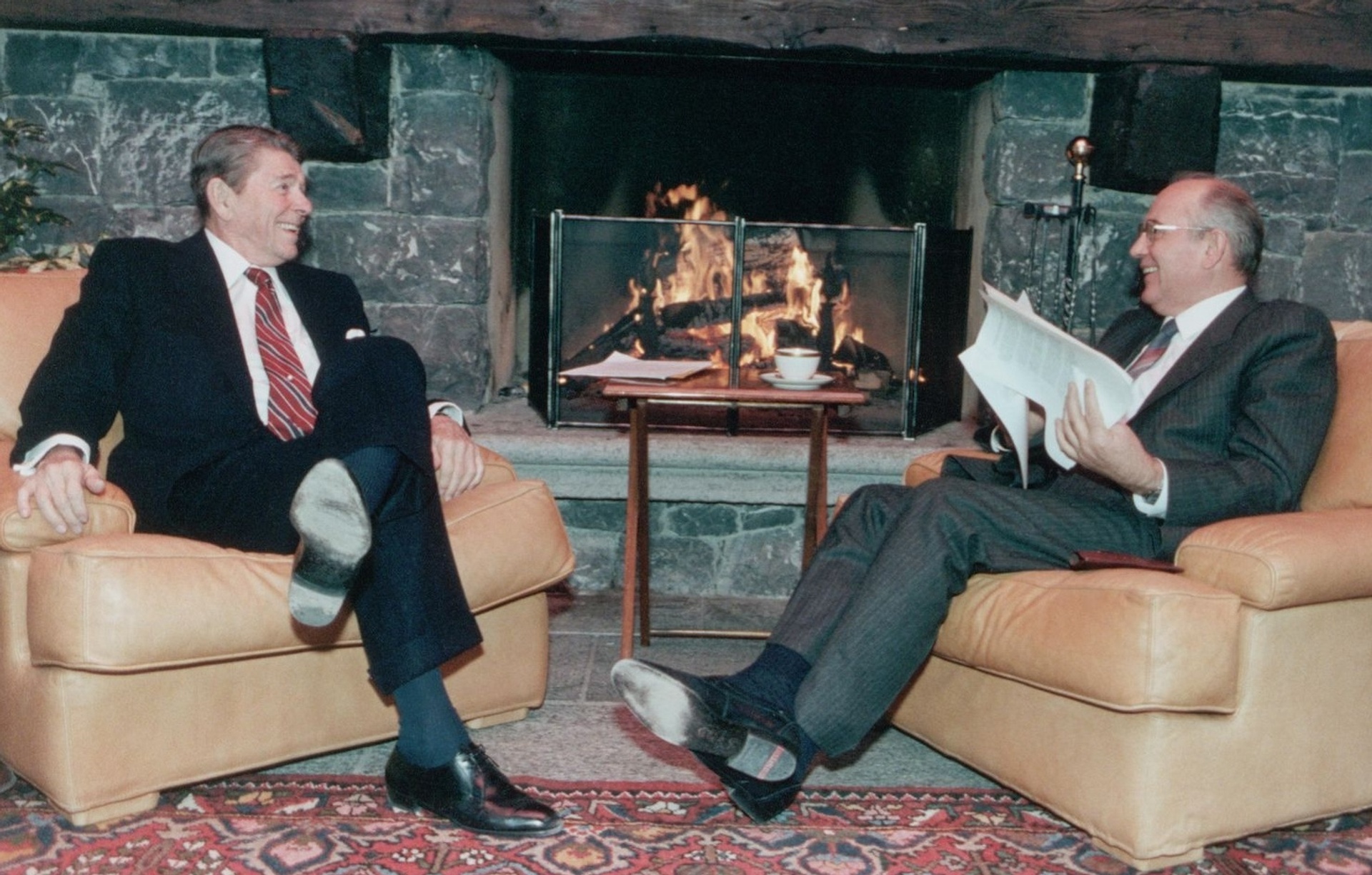
When Gorbachev came into office there was already a crisis of confidence in the Soviet system. The country was failing to overcome Brezhnev-era stagnation which was made worse by the financial burdens of the ongoing arms race and the war in Afghanistan. The decline was not only economic. With corruption, crime, alcoholism, and drug addiction running rampant, it appeared that the USSR was in cultural and moral decay as well. It was clear that something had to change if the country were to survive. Even though the idea of political and economic reform had not originated with Gorbachev but with his mentor Yuri Andropov, it would be Gorbachev who would bring his ‘new political thinking’ into practice and implement the reforms that attempted to open up the Soviet system, democratize their politics, and liberalize their economy. However, these reforms had not yet been announced when the diplomatic summitry between him and Reagan commenced in Geneva in November 1985.
Naturally, these were the types of changes that were in perfect alignment with the American objective of changing Soviet thinking and behavior as a prerequisite to ending the arms race and the Cold War. However, as far as Gorbachev was concerned, reforms only applied to domestic policy. He has admitted that upon his appointment as General Secretary he remained ‘totally dedicated to traditional Soviet goals’ and had no intention of changing the course of his country’s foreign policy from that of his more hardline predecessors. However, as Jack Matlock writes in his definitive account of the summits, Reagan would challenge Gorbachev to ‘think differently about Soviet security, the place of the Soviet Union in the world, and the nature of Soviet society. It altered both the substance of negotiations and the way the dialogue was conducted, but it did not require the Soviet Union to compromise its own security.’
Strategic communication
Perhaps the key differentiator of Reagan’s approach from that of his predecessors, and especially that of the Soviets, was the transparency of intent that underpinned his diplomacy. This transparency was a product of both Reagan’s confidence in the strength of the American position and his understanding of Soviet weaknesses, which largely stemmed from the CIA studies he commissioned early in his administration. He knew the Soviets were desperate to end the arms race because their attempt to compete with the U.S. was straining their already wretched economy. During the first meeting in Geneva, Gorbachev’s insecurity about this reality prompted him to preemptively deny it, before the topic was even broached. Although he had the reputation of a reformer, his instincts were still that of a Party functionary. This made the Americans suspicious of his intentions and made it difficult to establish trust, the lack of which was at the core of the nuclear arms race and the larger Cold War dynamic.
Reagan was weary of Soviet history of non-compliance with arms controls treaties, which was what prompted his uncompromising attitude on two critical items on the negotiating table—on-site inspection provisions that were absent from the Carter-era START II treaty and the SDI program. Both of these items were unpalatable for Gorbachev. Even as they ultimately came to an agreement on inspection—in addition to reducing the number of nuclear warheads and the number of troops stationed in Europe—SDI continued to be a problem. The more Gorbachev pushed against it, the more important it became for Reagan to keep it. After all, the program was defensive, not offensive, and Gorbachev’s insistence on limiting it only bred American suspicions that the Soviets still fostered ambitions for nuclear superiority. Although no agreement was reached in Geneva, the groundwork for future talks had been established.
For Gorbachev, an inflection point came on April 26, 1986, when an explosion at the Chernobyl nuclear power plant rendered a large swath of territory in the Ukrainian and Belorussian SSR uninhabitable. The response from his government, which initially downplayed the severity of the catastrophe in order to protect its reputation, made the dire situation even worse. Chernobyl heightened Gorbachev’s antipathy toward nuclear weapons but also brought to light the extraordinary failures of a system where secrecy and lies were inherent in the design. His drive toward liberal reforms was accelerating.
Several months later in October 1986, he and Reagan reconvened for another summit, this time in Reykjavik. Although he was now more open to compromise than he was in Geneva, Gorbachev’s persistent intolerance for SDI led to a tense exchange toward the end of the summit. Neither side was willing to yield and talks ultimately unraveled. The meeting was considered to be a failure at the time of its conclusion, but a retrospective reassessment reveals that it in fact was a turning point in Soviet thinking about their foreign policy. Once tensions subsided, a more cool-headed Gorbachev came to the conclusion that he would have to link his domestic and foreign agendas if he wanted to end the arms race that was crippling his country.
By the spring of 1987, he was talking about the ‘humanization of our international relations’ with his Politburo colleagues and making public declarations that ‘our foreign policy stems directly from our domestic policy to a greater extent than ever before’. In December of the same year, the U.S. and Soviet Union signed the Intermediate-Range Nuclear Forces (INF) Treaty during the summit in Washington, thus taking the first concrete measure to end the arms race. Later on, Gorbachev also dropped his efforts to limit SDI, which eventually paved the way for the START I Treaty that was signed by the subsequent George Bush administration.
Soviet withdrawal
Parallel to summitry, liberal-democratic reforms in the Soviet Union were intensifying and the official view on the status of the Warsaw Pact countries was changing. Gorbachev came to think that they had become more of an economic liability than an asset to the Soviet Union, and in 1988 he made the decision to withdraw troops from both Afghanistan and Eastern Europe, leaving those governments to their own devices. What helped justify this dramatic shift to himself was the legacy of his personal hero Vladimir Lenin, whom Gorbachev viewed as having made the pragmatic foreign policy move of signing the Treaty of Brest-Litovsk of 1918, which ceded control over vast swaths of Eastern Europe to Germany in order preserve the Soviet regime. In Gorbachev’s conception he was doing the same, and so he framed his decision as triumph of his ‘new thinking’ rather than a geopolitical defeat. By granting self-determination to Eastern Europe, he was acting in the interest of his own perestroika revolution and in the interest of preserving the Soviet Union.
The withdrawal from Eastern Europe opened the floodgates of revolution that quickly swept across the region in 1989 and led to the fall of communist governments in Poland, Czechoslovakia, Yugoslavia, Hungary, Romania and Bulgaria. The only place where Soviet troops were still stationed was East Germany, where they would remain until a great powers agreement was reached regarding reunification. In November, an ecstatic crowd dismantled the Berlin Wall and opened the free flow of people, and by end of the year, 340,000 Berliners had migrated from East to West. Early 1990 saw the initiation of the diplomatic process that came to be known as the ‘two plus four’ model, which put the two German states at the center of negotiations while the four occupying powers (U.S., France, UK and USSR ) were external partners.
A breakthrough in negotiations arrived in July during a summit between West German Chancellor Helmut Kohl and Gorbachev, during which Gorbachev conceded to the Western unification proposal that granted Germany full sovereignty and NATO membership, as opposed neutral status that the Soviets sought, paving the way for the signing of the Treaty on the Final Settlement with Respect to Germany in September 1990. From the point where Reagan and Gorbachev began their talks in Geneva in 1985, diplomatic negotiations around concrete policies related to disarmament and national security became tangible stands-ins for more abstract issues—the fundamental assumptions, values and ideals of their respective countries. Thus, ultimately it is a reflection of Western triumph in persuading Gorbachev to come around to an open and reconciliatory foreign policy position that made ending the Cold War and the reunification of Germany possible.
Gorbachev’s ‘Leninist’ revolution
The external factors discussed above were instrumental in setting in motion the fall of the Soviet Union. However, the seeds for its demise were planted not in the 1980s with Gorbachev, but at its conception between 1917 and 1921—with Lenin. The USSR was founded upon the pillars of Bolshevism, whose fundamental pillars rested upon the rejection of the bourgeois-democratic phase of Marxist teleology, the primacy of the political vanguard, and centralism of authority. These were in direct contradiction to the Mensheviks conceptions that favored Western-style philosophical universalism, compliance with capitalism, and decentralization of power. Strangely, Gorbachev personally identified with Lenin and thought of himself as true Leninist believer. He came into his position as General Secretary with the intention to revitalize the Bolshevik tradition, not destroy it. However, there was a fundamental dissonance in his revolutionary approach.
By taking reckless and misguided measures of liberalizing the economy and accelerate economic growth (uskorenie), opening up Soviet society (glasnost), and restructuring and democratizing the Soviet government (perestroika), he effectively removed the economic and political underpinnings that were holding the country together. This released forces that made it impossible for Gorbachev to hold onto control. He believed that relativizing the Party’s power would vitalize the Soviet polity and in turn secure the Party’s power and legitimacy. The consequences were the direct opposite. Essentially, he was attempting to achieve Bolshevik ends with Menshevik means. Moreover, he also underestimated the power of nationalism in the Soviet republics, believing that a powerful countervailing force of civic Soviet identification would trump ethnic demands. The latter Gorbachev realized the implications of his policies and tried to backtrack to authoritarianism, but it was too late. In August of 1991, Communist Party hardliners attempted to overthrow Gorbachev in a failed coup that evokes comparisons to the Kornilov Affair of August 1917, during which anti-revolutionary forces attempted to seize power of the government to prevent Bolshevik takeover. Soon, the last of the Soviet republics declared their independence and the USSR officially ceased to exist on December 25, 1991.
Never before and once again
In summary, this essay argues that, even though there was momentum toward domestic reform in the USSR upon Gorbachev’s arrival to power in 1985, the critical linkage between Soviet domestic reforms and foreign policy that paved the way to East-West cooperation and later the ‘two plus four’ talks that reunified Germany were triumphs of U.S. policy, and more specifically, triumphs of Reagan’s diplomacy in persuading Gorbachev to bridge the policy gap. On a domestic level, however, the corrosion of the Soviet system’s foundation made it impossible for him hold the country together and thus spelled the end of an empire.
In many regards, the collapse of the Soviet Union reset Russia to its situation after the fall of the monarchy and prior to the Bolshevik Revolution, that thin sliver of time between February and October 1917 when the county had a fragile opportunity to go down a liberal-democratic road. The same opportunity was presented to the new Russian Federation in the 1990s, but it was lost once again as it steadily regressed into autocratic rule under Vladimir Putin. Thus, retrospecting from our current vantage point, the Soviet experiment appears to be little more than a long and treacherous detour in history, the legacy of which continues to haunt the psychology and security of people both inside and outside Russia.
Two famous aphorisms attributed to the politician Viktor Chernomyrdin capture the Russian cynicism bred from repeated historical tragedies: ‘This has never happened before, and now it’s happening again’; ‘We wanted things for the better, but they turned out as always’.