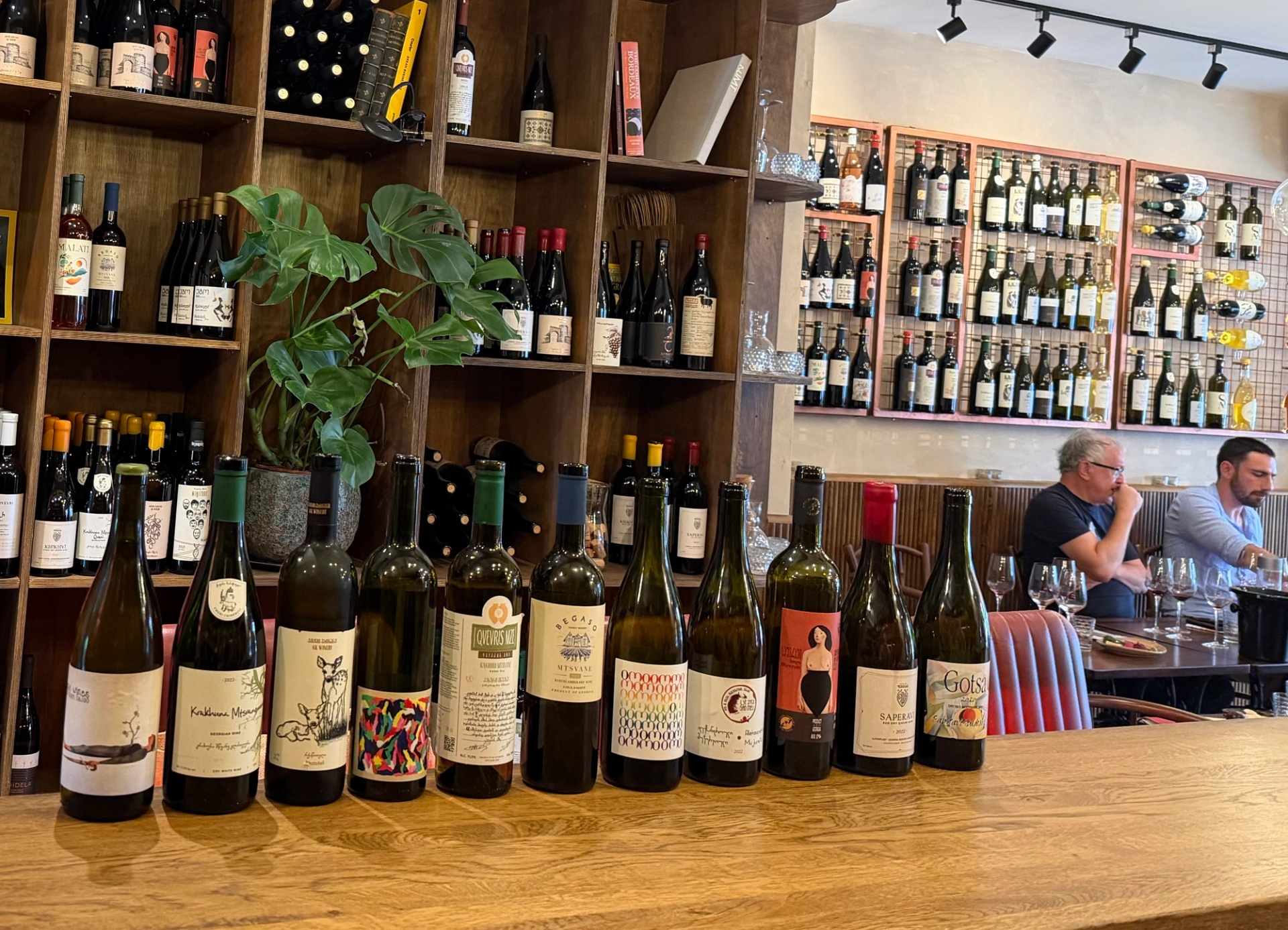
By Victor Topouria, Founding Partner
Minding the Gap
There is a category of cultural products that arrive in foreign markets burdened by the weight of their own origin stories. Some goods have a history that is so rich, so particular, so entangled with the fate of a people, that it becomes difficult to determine whether that history is their greatest commercial asset or the most persistent obstacle to their wider reception. In the beverage industry, Japanese sake, Mexican mezcal, and Greek wine come to mind as recent examples: drinks whose complex identities and market positions proved difficult to articulate internationally, but whose audiences eventually found them after years of coordinated effort.
Georgian wine also belongs to this category.
The oldest winemaking culture on earth. Over 500 indigenous grape varieties rivalling Italy in terms of pure biodiversity. A UNESCO-listed qvevri tradition. A viticultural heritage nearly destroyed under Soviet mass production and only partially recovered since independence. These are among the elements that make up the deep, complex history that has shaped the identity of Georgian wine, how it is made, what it tastes like, and why it is so frequently misunderstood by the Western consumer who is only now beginning to encounter it. What Georgian wine lacks is not raw material, but a coherent identity in the minds of its most desired audiences.
The customer base is growing regardless: exports to the UK alone grew 72 percent between 2024 and 2025. The question is whether the industry can articulate a narrative that will capitalise on that momentum.
Simon Anholt, a pioneer in the field of nation-branding and the creator of the Good Country Index, maps what he calls a country’s ‘competitive identity’ across six pillars: tourism, exports, government, investment, culture and heritage, and people. He argues that a country’s external image (or reputation) functions as a form of equity that is accumulated through sustained, coordinated action across all of those channels simultaneously, and undermined not by bad communication, but by incoherence between them. Where those channels pull in different directions or signal contradiction, the result is a value discount applied to everything the country produces.
Georgian wine illustrates this dynamic with uncomfortable precision. The quality exists. The story exists. But the coordination remains inadequate.
It is this gap, between what Georgian wine is and what the world currently understands it to be, that formed the animating concern of a tasting and panel discussion hosted by Topouria Group in collaboration with Les Caves de Pyrene at Saperavi Social in London on 1 July, 2026. Widely regarded as the world’s most competitive wine market, London is certainly the right place for this conversation. If Georgian wine can earn its place here, it can earn its place anywhere.
Our Panel
Moderated by Liam Spindler (Founding Partner at TG), the panel brought together three professionals whose combined experience spans the full range of what the Georgian wine trade currently requires:
Douglas Wregg—sales and marketing director at Les Caves de Pyrene, the UK’s largest importer of Georgian wine—noted at the outset that Georgia itself is the most powerful argument for its wine. It’s impossible to visit the country without falling for its wine culture, making tourism the single most effective conversion mechanism the category has.
Paul McSharry, a brand strategist and the founder of MAZE Drinks, currently works with the Georgian producer Ikano Estate. His opening observation was that the 8,000-year history, the qvevri, and the natural wine connection are all powerful hooks, but they are not the full story. The challenge is to extend the narrative without abandoning what makes it compelling.
Davit Berulashvili, owner of Saperavi Social alongside his brother Giorgi, is both an importer and distributor of Georgian wines and a direct embodiment of what Anholt calls the people pillar: a Georgian in London, making the case for his country’s wine through the daily practice of running a restaurant and personally sourcing its cellar.
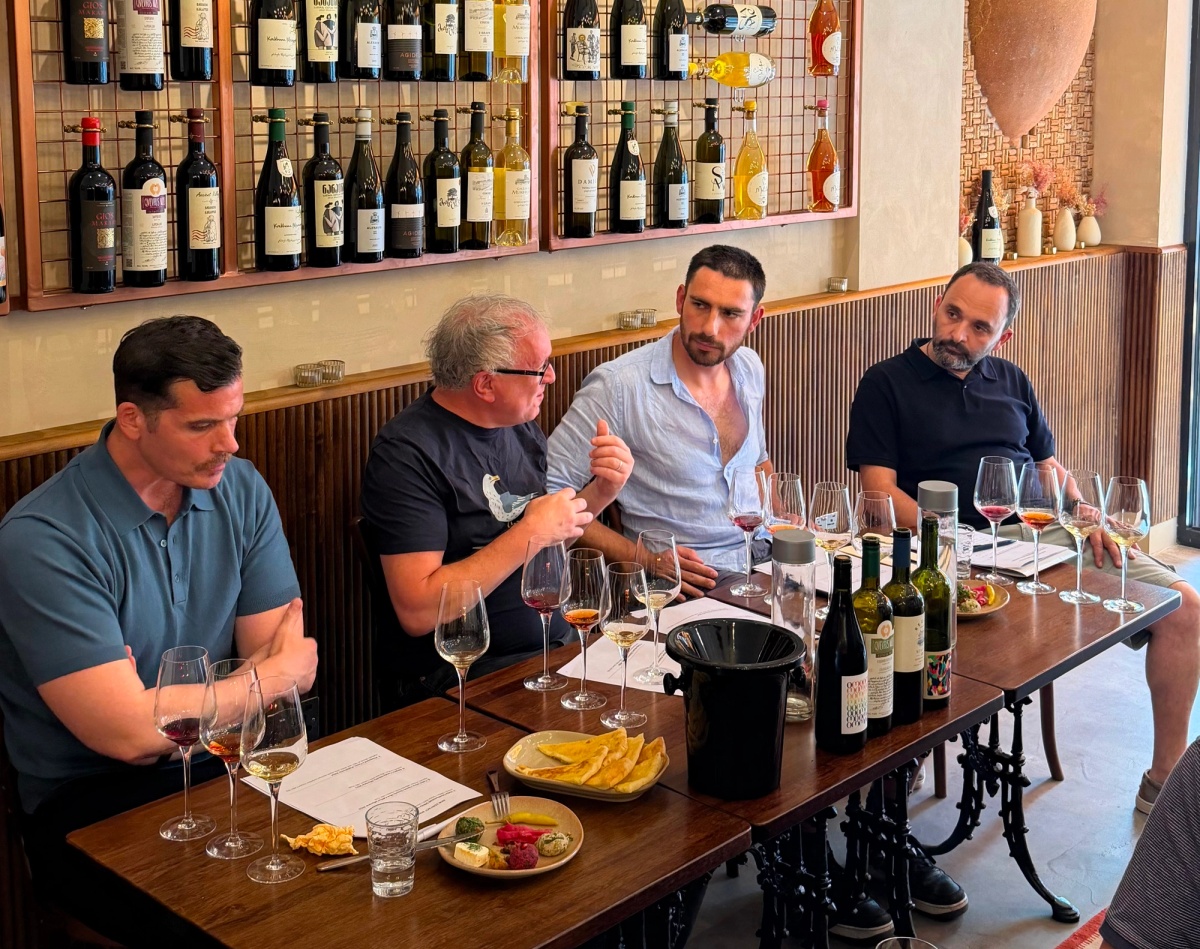
The panel, joined by fifteen representatives from London's wine trade and press, sampled and discussed eleven wines over the course of the afternoon: three “European-style” whites, four skin-contact qvevri wines (a white, two ambers and a blend), and four qvevri reds.
*Unless marked otherwise, all wines presented in the tasting can be purchased at Saperavi Social at 212 Essex Road, Islington, London, N1 3AP*
Flight I: The Fresh Whites
- Igavi Wines, Tsolikouri 2023 Lechkhumi, Tsolikouri 100%, Aged in Georgian acacia barrels, ABV 10% (from Les Caves de Pyrene)
- Churi Chinebuli, Krakhuna Mtsvane 2022, Imereti, Imeretian Krakhuna 50% Kakhetian Mtsvane 50%, ABV 13.5%
- GK Winery, Rkatsiteli 2023, Kakheti, Rkatsiteli 100%, Aged on lees, ABV 12%
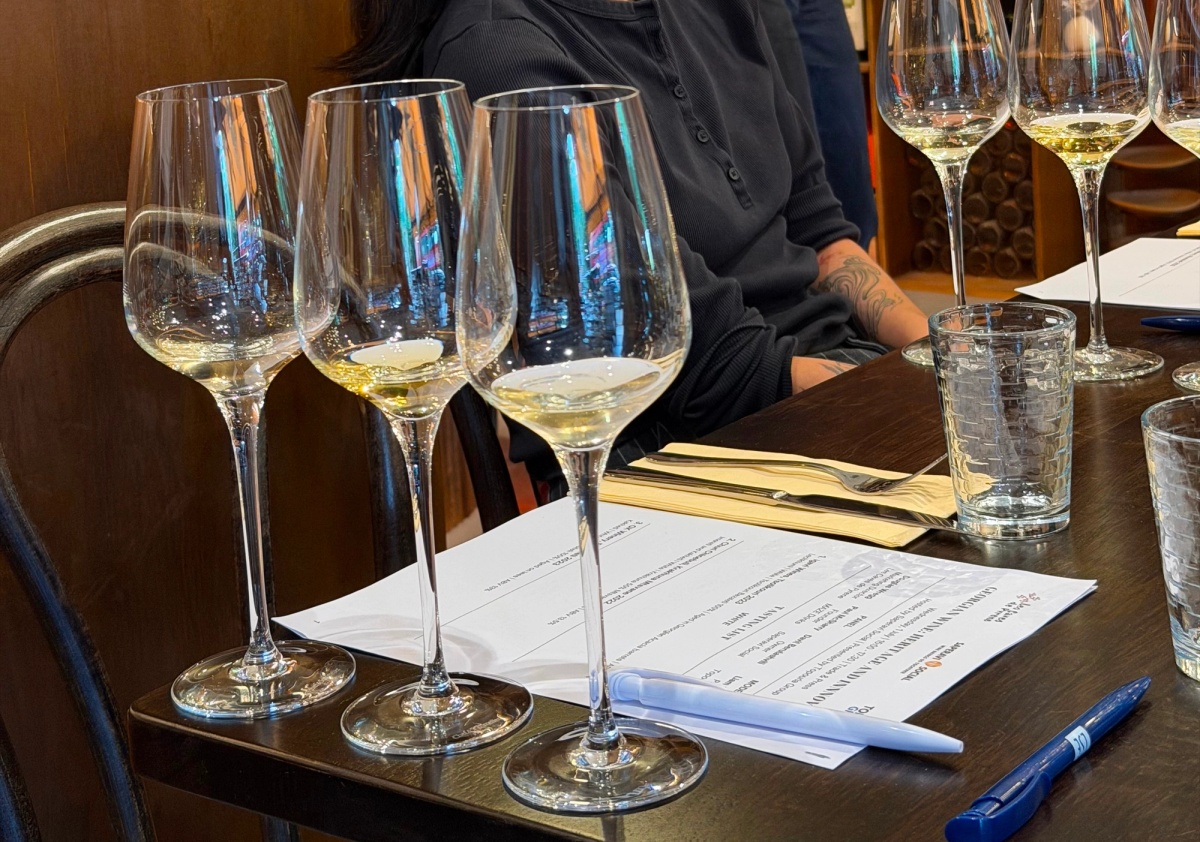
A country’s export brands function as ambassadors, each bottle carrying the national image into the market, either reinforcing it or contradicting it. The three whites that opened the tasting illustrated what the export channel for Georgian wine could be communicating and the degree to which it currently falls short.
Aged in Georgian acacia barrels, the delicate and pleasantly acidic Igavi Tsolikouri 2023 from the mountain region of Lechkhumi (northwest Georgia) brings a pure cool-climate minimality that signals a new direction in Georgian winemaking as much as it evokes an ancient one. The 2022 Krakhuna Mtsvane by Churi Chinebuli, with its tropical fruit notes, beautifully marries the denser character of Kakhetian Mtsvane with the levity of Imeretian Krakhuna. The 2023 Rkatsiteli from GK Winery is crisp, clean, herb-flecked, with a refreshing finish that asks nothing of the drinker in terms of prior context.
Three glasses that represent three distinct regional registers and four grape varieties most British consumers could not name. Yet, this is the version of Georgian wine that maps perfectly onto what the modern British wine drinker is already reaching for. The story is not being told effectively enough.
Georgia’s international profile has been constructed almost entirely around Kakheti’s output (particularly the qvevri-aged amber wines) leaving the regions that produced two of these three wines largely invisible. But this is not due to lack of distinction, but because the infrastructure of communication that would allow them to function as additional signals in Georgia’s national identity has not been built.
The flight also surfaced a corrective to a narrative gaining currency in wine trade commentary: that Georgia’s diversity of altitude gives it a structural advantage over struggling European wine regions. Wregg pushed back. Two Georgian vintages in the last five years were very nearly lost to extreme climatic events; very few vineyards are planted on slopes that would offer mitigation. The honest picture is of a country facing the same disruptions as its counterparts, with less institutional capacity to respond.
Flight II: A Spectrum of Skin Contact
- Natia Chekhurishvili’s White Mulberry Winery, Tsitska 2024, Imereti, White, Tsitska 100%, Qvevri, ABV 12% (from Les Caves de Pyrene)
- Qvevris Mze, Kakhuri Mtsvane 2022, Kakheti, Amber, Mtsvane 100%, Qvevri, ABV 11.5%
- Begaso Family Winery, Mtsvane 2022, Kakheti, Amber, Mtsvane 100%, Qvevri, ABV 13.5%
- Pheasant's Tears, Poliphonia 2024, Kakheti, Blend of 140+ white, pink, red and black skinned varieties (from Les Caves de Pyrene)
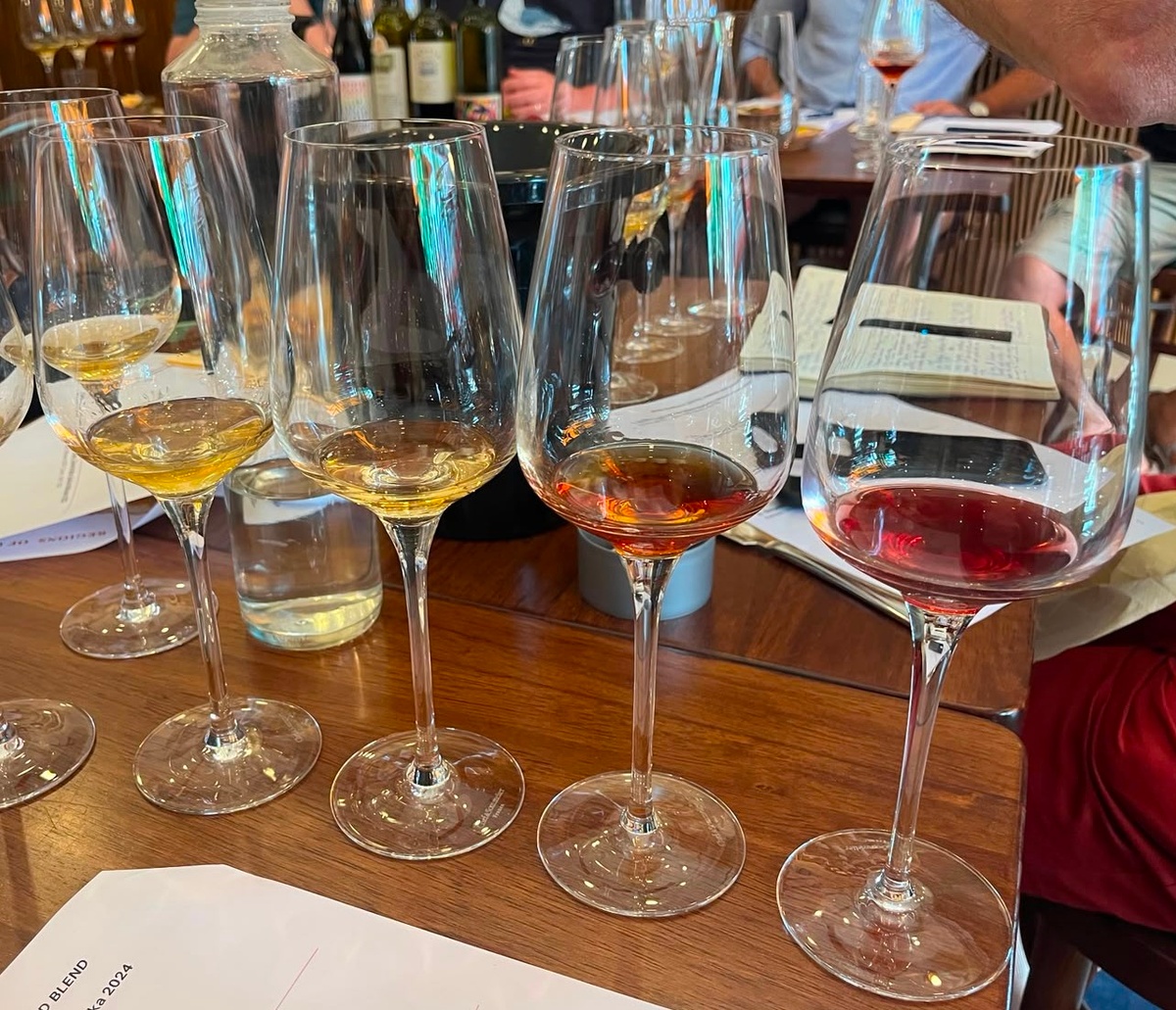
All four wines in this flight were fermented and aged in qvevri, and so a brief demystification is in order: The qvevri is a large clay vessel buried to its neck in the ground, where the surrounding earth regulates its temperature throughout fermentation and ageing. It is one of the most distinctive identifiers of Georgian wine and one of the most misunderstood. Unlike oak, it imparts no flavour of its own. What it does contribute is texture, a particular kind of oxidative complexity, and a stability that winemakers in Georgia have relied on for millennia. In the West, qvevri is often conflated with amber wine, as though the vessel and the style were synonymous. They are not. The four wines in this flight were made with varying durations of skin and stem contact and markedly different techniques, which is precisely why they taste so different from one another. Understanding what a qvevri does, and does not do, is essential to understanding how the same vessel can produce such divergent results.
We opened the flight with Natia Chekhurishvili’s Tsitska 2024, characterised by the purity and minerality that defines traditional Imereti-style wines: full-bodied, bright and flowery, with yellow fruit notes and a long mineral finish. This a light skin-contact white that challenges what the amber category is assumed to mean.
The two distinct Kakhetian Mtsvane expressions that followed drive this point home. Qvevris Mze Kakhuri Mtsvane 2022 is pale and restrained, with a savoury, nutty and gamey complexity and a strong tannic grip. It would pair well with any aged hard cheese or Georgian Guda if you can get your hands on it. Begaso Family Mtsvane 2022 is deeply amber, bone-dry, its nose reaching toward dried apricot and burnt caramel, with a smokey complexity that lands closer to cognac or scotch than to anything the word ‘amber’ is conventionally associated with.
The explanation for the difference came from Berulashvili: Begaso’s winemakers sun-dry the grape stems before adding them to the qvevri alongside the must, a technique that contributes the additional depth of colour, the smokiness, and the particular texture that makes the wine so memorable.
The same variety, aged in the same vessel, yielding two entirely different wines. This is why, as both McSharry and Wregg argued, one should resist the impulse to colour-code wine: the complexity and diversity of what the qvevri produces is precisely its selling point, and ‘amber’ is too blunt an instrument to carry it.
The final wine of the flight was Pheasant’s Tears Poliphonia 2024, a blend of more than 140 white, pink, red and black-skinned native varieties vinified together in qvevri. Although perfectly drinkable, it is perhaps better understood as a manifesto than an expression of terroir. It is a conceptual celebration of the country’s viticultural diversity. That this wine exists at all is a statement about the scale of what was nearly lost under Soviet rule.
The collectivisation of agriculture not only standardised and industrialised Georgian wine production, but also deliberately reduced the country’s viticultural inheritance, clearing land for a handful of high-yielding varieties at the expense of hundreds of others. Of course, commercial winemaking outside the centralised system was outlawed, so the only factor preventing total obliteration was that a large proportion of Georgian households continued producing their ancestral wines for their own consumption, which kept many varieties alive, often without knowing their names. Other varieties survived in vineyards that were simply left untended.
The recovery since independence has drawn on all of these sources: the memory of village producers, the identification of surviving specimens, the patient work of genealogical research, and the work remains incomplete. Poliphonia serves as a kind of record of that ongoing excavation.
The Globalisation of Qvevri
The exchange of knowledge around the qvevri has not been unidirectional. The dominant narrative of the Georgian wine renaissance—where winemakers are reclaiming a tradition that Soviet rule suppressed—is largely accurate, according to Wregg. But what it sometimes omits is the inverse flow: winemakers from Europe, the Americas and beyond have made the journey to Georgia specifically to study a tradition that predates their own, returning not only with knowledge but with the vessel itself. Meanwhile, the presence of outsiders has allowed Georgian producers to interrogate and refine European winemaking techniques while simultaneously deepening their understanding of their own traditions.
The qvevri is now visible across winemaking cultures from Friuli, Italy to Slovenia and even South Africa, where it is being used to produce varieties like Chenin Blanc. All of this is a validation of Georgia’s heritage pillar in its competitive identity, and perhaps its most unexpected one.
The challenge is that this adoption is happening faster than Georgia is building the institutional infrastructure to ensure that qvevri remains both a protected designation of method and a marker of Georgian origin. Methods that powerful cultures fail to protect have a habit of becoming generic, and the qvevri is already showing early signs of that drift. Some producers have begun labelling wines as “qvevri” on the basis of skin contact alone, detached entirely from the vessel, the method, or the country that originated both.
Current regulatory protections in Georgia are not just inadequate, but actively counterproductive: existing laws have sacrificed designation integrity in exchange for short-term commercial interests, permitting mass-produced wines to capitalise on qvevri labelling in ways that erode the very distinction Georgia should be building its global identity around.
So, if the qvevri label devolves into a loose stylistic descriptor rather than a protected designation of origin and method, Georgia loses a core feature of its wine identity that no other country can replicate.
Flight III: Rich Qvevri Reds
- Sad Meli Winery, Aleksandrouli Mujuretuli 2022, Racha, Aleksandrouli 50%, Mujuretuli 50%, Qvevri, ABV 14%
- Wine Thieves, Saperavi 2020, Kakheti, Saperavi 100%, Qvevri, ABV 13%
- Periani Winery, Saperavi 2022, Kakheti, Saperavi 100%, Qvevri, ABV 15.5%
- Gotsa Winery, Saperavi Budeshuri 2020, Kartli, Saperavi Budeshuri 100%, Qvevri Red, ABV 15%
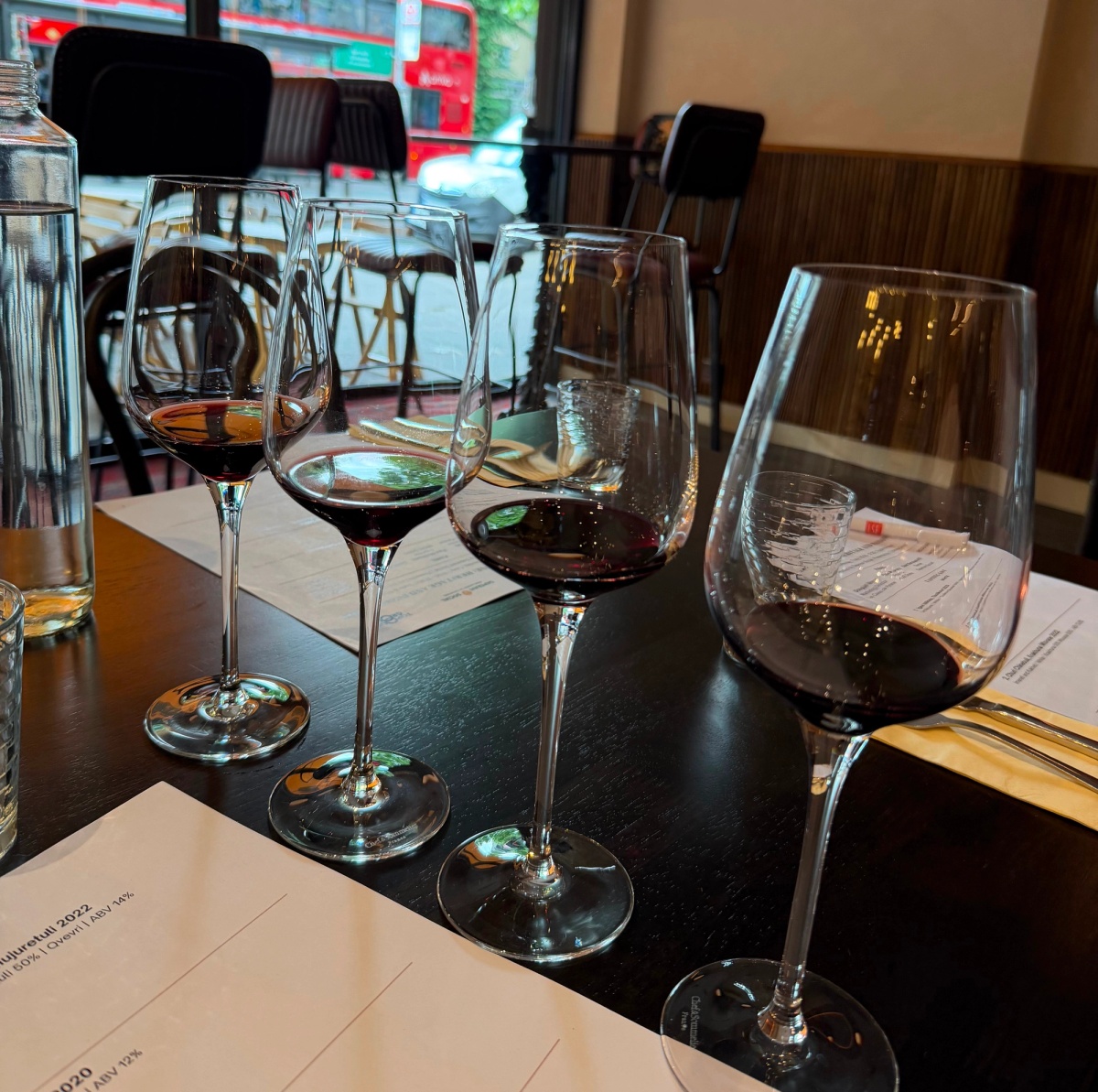
The red flight opened in Racha, in Northwestern Georgia, with Sad Meli’s Aleksandrouli Mujuretuli 2020—a 50/50 blend of two varieties almost entirely unknown in Western markets, from a mountain wine region that produces some of Georgia’s best reds. Medium-bodied with vibrant red fruit notes, low tannins and strong mineral finish that reminds us of its cool climate, high altitude origins. The semi-sweet expression of this same blend is known as Khvanchkara, whose commercial identity remains strong in the Russian market, where tastes still tilt toward the industrial, semi-sweet wines that were the staple of Soviet mass production.
(Khvanchkara and Kindzmarauli, the semi-sweet expression of Saperavi, are both claimed as Joseph Stalin's favourite wines, which is a distinction that remains commercially active in Russia today, where consumers often find bottles still sold bearing his likeness on the label—an act of kitsch that is deeply revealing about a market Georgian wine has historically depended on.)
Sad Meli’s dry qvevri interpretation is a conscious act of reclamation.
The gap between those two versions of the same blend is the gap between how Georgian wine has historically been consumed in Russia and the post-Soviet space and how it is being sought in Western markets like the UK and USA. However, with over 60 percent of all Georgian wine exports still destined for Russia, over-reliance on a market that absorbs volume on its own terms actively pulls the category away from the story its best winemakers are trying to tell.
The Aleksandrouli Mujuretuli was a useful prelude to what followed: three versions of Saperavi and a question about how one grape can become the entry point through which a nation’s entire wine culture can be discovered.
The analogy put forth by McSharry is that of Malbec, Argentina’s most famous grape. Malbec did not merely give Argentina a flagship variety; it gave the international market a point of attachment specific enough to be memorable and simple enough to repeat, and in doing so opened a door through which the broader complexity of Argentine wine eventually followed.
Saperavi offers Georgia something comparable. It is a grape with a distinctive, immediately recognisable character: bold acidity, deep cherry fruit, structured tannins, black fruits and sweet spice on the nose, a firmness and fullness that rewards time in the glass, as well as a capacity to age that few red varieties can match.
Wine Thieves Saperavi 2020 is a boutique expression from a single vineyard in Kvareli, which shows the variety at its most precise, full-bodied and refreshing in equal measure. Next, Periani Winery’s Saperavi 2022, at 15.5% ABV, demonstrated how the variety, even at its most concentrated and powerful, can carry that weight without showing it, the alcohol absorbed into the structure so completely that it registers as richness rather than heat.
However, if Saperavi is pressed too hard as a national identifier, it risks becoming the ceiling it was meant to open. Gotsa Winery’s Saperavi Budeshuri 2020 made this argument without needing to state it. A rarer biotype with smaller berries and thinner skin, biodynamically farmed in Kiketi just outside Tbilisi by the Gotsadze family (among the pioneers of Georgia’s natural wine renaissance), it is deeper, inkier, and more savagely fruited than a traditional Saperavi, with dried plum emerging as the dominant note. Similar to Periani, its 15% ABV is absorbed into the wine’s velvety texture. It is the kind of wine that renders the question ‘what is Georgian red wine?’ unanswerable in any satisfying way, which is precisely its value at the end of a long and diverse tasting session.
When it comes to Georgian reds, Saperavi is certainly the gateway, but what lies beyond are beautiful varieties like Aleksandrouli, Mujuretuli, Budeshuri, Shavkapito, Tavkveri and those that don’t yet have names familiar enough to print on a label in London.
Recommendations: Articulating a Coherent Competitive Identity for Georgian Wine
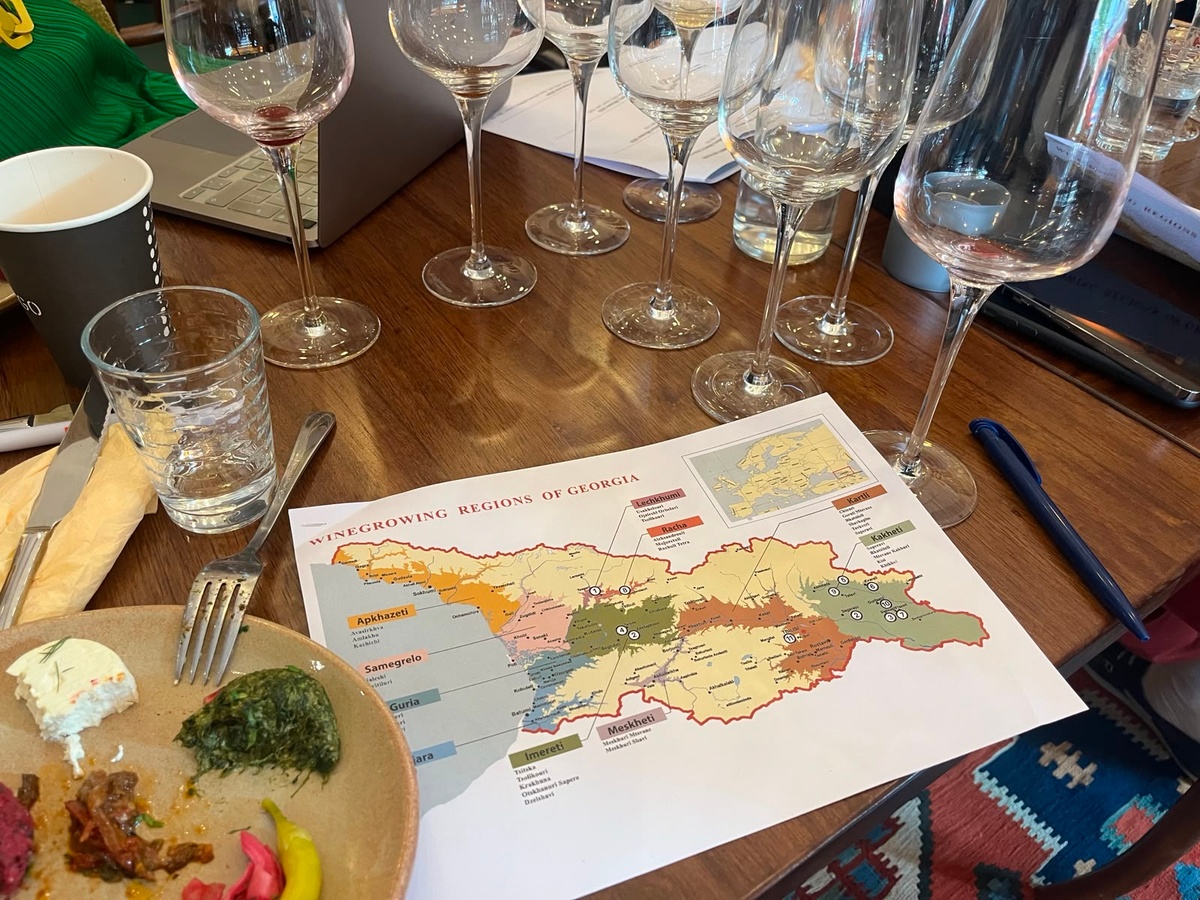
What the afternoon at Saperavi Social confirmed, flight by flight, was that Anholt’s diagnosis applies with precision to Georgian wine: the six pillars of the country’s competitive identity are not coordinating. Until those signals cohere, the discount remains and no amount of quality in the bottle compensates for incoherence in the channels that carry it.
The commercial and logistical realities are not trivial either. Berulashvili described importing once a year in a single container, navigating compounded logistics costs, and paying upfront before vintages are released simply to secure allocations. Wregg’s view on price is sound: a good Georgian wine at a premium is not at a disadvantage. The quality justifies the cost. But it presupposes a consumer already equipped with the reference points to make that comparison. Building those reference points is the strategic communications task and it cannot be left to importers and restaurateurs alone.
The following takeaways emerge directly from the afternoon’s conversation:
1. Name the narrative and hold to it. The category’s core story is twin-pillared: unique heritage and diversity of varieties. The idea of “8000 vintages” signals both the depth of history and the vastness of choice. That combination translates directly into commercial range: from the fresh, accessible whites the modern Western palate is already reaching for, to the full spectrum of the qvevri, to the structured, age-worthy reds that run from Saperavi as an entry point to an entire world beyond it. This story exists. It needs to be stated clearly, consistently, and from a single coordinated voice across every channel.
2. Put Georgia’s best producers at the centre of communications. The most credible version of Georgia’s wine story does not come from a trade body or a government campaign. It comes from the hands that make the wine. A coherent communications strategy must distill a competitive identity that is grassroots in origin, built around the producers who are doing the most interesting work, rather than imposed by commercial or institutional interests. The reward is a message that is truthful, authentic and aligned with Georgia’s inherent identity.
3. Establish Saperavi as the flagship variety. Saperavi is bold, accessible, and easy to pronounce. It performs the function Malbec performed for Argentina: a variety legible enough to anchor the category in a new market, distinctive enough to hold attention once it gets there. Its strategic value is not in Saperavi alone, but in what it makes possible: Aleksandrouli, Mujuretuli, Budeshuri, and hundreds of further varieties that Western markets have barely encountered.
4. Protect the qvevri before it becomes generic. The vessel is already being adopted globally faster than Georgia is building the institutional protection needed to keep it tethered to its origin. On a domestic level, Georgian legislators must restrict qvevri labelling to wines actually fermented and aged in the vessel, and revise the current loopholes that permit mass-produced, skin-contact wines to appropriate the designation for commercial gain. A wine that has never touched a qvevri has no business carrying its name. This is primarily a legislative task, but communications can build the public and trade pressure that makes legislators act.
5. Build institutional infrastructure for small producers, not just for volume exports. Georgia’s finest wines come from small, independent producers working with indigenous varieties, in the diverse terrains across the country, largely without access to the capital or support structures that would allow them to scale sustainably. The current institutional architecture rewards volume production optimised for the Russian market. Redirecting that support—through targeted grants, technical assistance, slope planting incentives, and protected designations with enforcement—would do more for Georgian wine’s long-term reputation than any campaign. The story is in these producers. The investment must reach them.
6. Treat the Russia dependency as the strategic vulnerability it is. Over 60 percent of Georgian wine exports are still destined for Russia, a market whose tastes pull commercial incentives in precisely the opposite direction from the category’s best work. Although the scale of that market is commercially tempting in the short-term, it reinforces Georgia’s strategic vulnerability by shaping what gets made, what gets funded, and what story Georgia tells about itself. Diversification into Western markets is not simply a commercial opportunity. It is the condition under which Georgia’s most distinctive producers can survive and grow.
7. Remove structural barriers to Western markets through policy, not marketing. Lower import duties, protected designations with teeth, and coordinated export facilitation in the UK and US are policy responses to a structural problem and should be treated as such. No campaign compensates for the friction that compounded logistics costs, upfront allocation payments, and the absence of trade support impose on importers who want to bring Georgian wine to Western shelves. The infrastructure has to be built before the story can travel at scale.
8. Take the long view and commit to it. The producers most likely to define Georgian wine's global reputation are not necessarily its largest. Institutional support, export infrastructure and communications resources must reach the small, quality-driven producers whose wines are already earning recognition in the markets that matter. They should not concentrate around volume players whose interests lie elsewhere. This also means thinking 10, 20, 30 years ahead: investing in climate resilience, replanting on appropriate slopes, preserving varietal diversity before more of it is lost. Above all, it means establishing a shared vision for what Georgian wine can be in the world and building everything else around that. No category has ever found its audience by accident. The ones that did it well knew early what they were trying to become.
Georgia is not an ‘emerging’ wine region. It is the cradle of viticultural civilisation, re-entering a conversation from which it was violently excluded for most of the twentieth century. Reputation, as Anholt insisted, is not built in one campaign cycle. It is built over years of coherent, consistent action across every channel that carries a country’s signal: its exports, its culture, its institutions, its people. And then, one day, it is simply there. The afternoon at Saperavi Social was one small instance of that patient, necessary work.